FINE ART WITH HEART
The Telstra National Aboriginal & Torres Strait Islander Art Awards (NATSIAA) is the longest running and most prestigious First Nations art award in the country, gracing the walls of the Museum and Art Gallery of the Northern Territory (MAGNT) for over 40 years. You’ve got until the end of January to catch it.
WORDS RITA HORANYI
THE 2025 TELSTRA NATSIAA features 71 exceptional works selected from over 200 entries, continuing the Awards’ legacy of showcasing the vibrancy of First Nations art from around the continent.
From humble beginnings as a 10-day exhibition with a prize pool of $2,000, the Telstra National Aboriginal and Torres Strait Islander Art Awards has grown into an internationally recognised celebration of First Nations art, with a top prize of $100,000. It’s become a launching pad for the careers of some of Australia’s most significant contemporary artists.
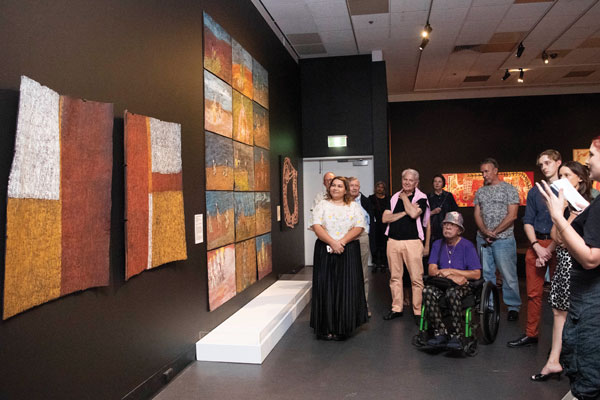
Director of MAGNT, Adam Worrall, believes this elevation of First Nations artists is one of the most crucial aspects of the Awards.
“Many of Australia’s greatest Indigenous artists we first met through NATSIAA. They hadn’t had a national profile … and then they won a category or an Award, or they became a Finalist, and they are absolute rock stars around the world. It’s amazing to see that transformation,” he says.
As the country’s premier First Nations art award, the NATSIAA attracts upwards of 200 entries from every corner of the country, from remote art centres to urban hotspots. As a result, the Awards exhibit an extraordinarily diverse range of forms, from sculptures, bark paintings, etchings, and multimedia work to paintings on canvas and works on paper.
“Last year, I had the recently retired Director of the Louvre Museum come and stay with me and go to the show, and he couldn’t believe the diversity of Indigenous art in this country,” Worrall says.
“After he saw the show, I realised a lot of people’s understanding of Indigenous art – if they're from outside of Australia – is bark paintings with ochres and that’s it. People are really amazed to see contemporary works when they don’t have a lot of experience with Indigenous art, and this is on full display in every NATSIAA exhibition.”
Since its inception, the NATSIAA has been crucial in amplifying significant new trends in First Nations arts practice that have gone on to shape contemporary fine arts across the country. An excellent example of this is the way appreciation of fibre art has grown over the years. In 2005, Tjanpi Desert Weavers took out the First Prize (now known as the Telstra Art Award) for their iconic large-scale woven Toyota Landcruiser ute.
“That really changed the way a lot of institutions look at weaving. It propelled weaving into the fine art category,” Worrall says.
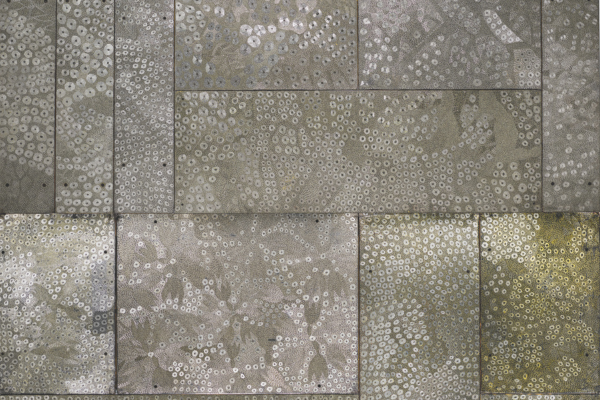
This year’s exhibition showcases some groundbreaking innovations, including the overall Telstra Art Award winning piece, Burwu, blossom, by Gaypalani Wanambi from Yirrkala. Intricately etched on the back of discarded road signs, the piece depicts stringybark blossoms and thousands of bees, referencing an important ancestral songline for the Marrakulu clan about Wuyal, the honey hunter.
“It is an absolutely spectacular work … a very deserving winner,” Worrall says.
It’s a piece that demands to be viewed in person, so if you haven’t yet had a chance to explore the visual splendours of this year’s exhibition, take this as your sign. With the etching catching the light and appearing to move as people walk around it, the work beautifully captures the vibrating energy of beating bee wings and being on Country.
Wanambi is the daughter of renowned artist Wukun Wanambi (1962–2022). While she grew up assisting him with his art and was taught designs by her father, she began producing work as an artist in her own right.
“Originally, we worked on the designs of our clan’s saltwater Country. I used to help him with that. After that, I began to paint the honey from the freshwater Country. I showed those designs to him, to my father, my paintings of the honey. That is when he told me, ‘Great! You will take this design now as your own and you will paint this when I am no more,’” says Gaypalani.
Another piece in the exhibition calling to be experienced in person is a huge collaborative work by 14 female artists from Ampilatwatja, RLKEYEL (blooming, coming out). Bringing generations of women together to create and share stories, the painting is a testament to connection to community, culture, and Country.
“We sat around that big canvas on the floor and painted strong, we shared stories and remembered the old ladies that sat together long time ago when they were young and painted side by side,” the group says.
“We paint Arreth, strong bush medicine, we hunt and gather, we connect to Country, we connect to family, we connect to each other. We sing to Country, singing the bush medicine into existence.”
For Worrall, it’s one of the standout pieces of this year’s exhibition.
“It’s a spectacular piece, because you can’t really see where one hand has started and ends, it seamlessly blends together… It’s enormous and it’s really powerful in the space,” he says.
With all artworks created over the past year, NATSIAA also offers viewers insights into some of the issues and themes that are most important to First Nations people today, from challenging racism to nuclear testing.
Head down to MAGNT and prepare to be blown away by the creative brilliance that channels 65,000 years of continuous culture.
Telstra National Aboriginal and Torres Strait Islander Art Awards
WHEN DAILY ‘TIL MON 26 JAN (EXC. PUB HOLS)
AT MAGNT
COST FREE
INFO magnt.net.au
Header, thumbnail and inset: 2025 Telstra NATSIAA. Museum and Art Gallery of the Northern Territory. Photo: Georgina Campbell.
Inset: Gaypalani Wanambi, 'Burwu, blossom' (detail), 2025, etched steel panels, aerosol paint, 299x299x3cm. Courtesy of the artist and Buku-Larrŋgay Mulka. Photo: Georgina Campbell.