FROM WHERE THE CURLEW BARKS
The annual Tiwi art blockbuster presented by Munupi Arts & Crafts Association and Jilamara Arts & Crafts Association returns to Darwin.
WORDS CADDIE BRAIN
WHEN THE WAYAYI (curlew) cries at night, Tiwi artist Carol Puruntatameri thinks of Purrukapali – a creation story of Melville Island from a time before death.
Purrukapali lived with his wife, Bima, and their son, Jinani. Each day, Bima would gather food, often leaving Jinani resting under a tree so she could secretly meet with Japara, an unmarried man. One scorching day, Bima left her child for too long, and he died in the heat. Overcome with grief and fury, Purrukapali refused Japara’s desperate offer to revive the child, locking them in a deadly struggle.
Carrying his son’s body, Purrukapali walked into the sea, declaring that death would now befall all people – a turning point for Tiwi people, when immortality ended. Japara became the moon, destined to die and be reborn each month. Bima became wayayi, the curlew, mourning eternally with her haunting cry.
“That’s where the first suicide came from,” Puruntatameri says.
“Today, when we sit around the fire telling stories to our children and grandchildren, we remind them: listen at night. The curlew is still crying for her son.”
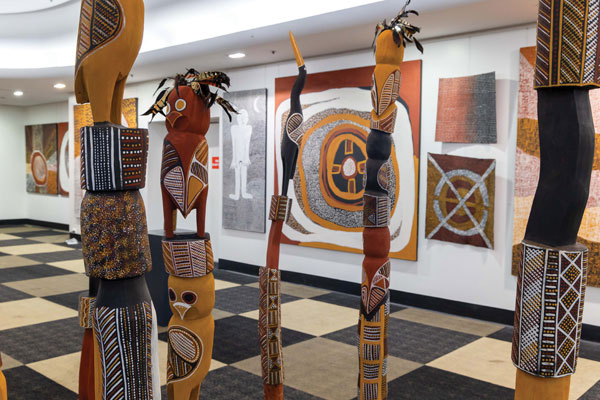
This story of loss and transformation is brought to life in her new bark painting, featured in Kimirrakkinari (The Season of Smoke), the annual joint exhibition by Munupi Arts & Crafts Association and Jilamara Arts & Crafts Association.
Held each August at DoubleTree by Hilton as part of the Darwin Festival, the exhibition coincides with the Darwin Aboriginal Art Fair, a highlight of the festival season.
Showcasing a powerful selection of Tiwi works, the exhibition features paintings and carvings, rich in local ochres and iconic motifs such as jilamara (body painting designs). But it’s the works on bark that take centre stage this year. Puruntatameri is among them.
“We are bringing back our ancestors who used to paint on bark,” she says.
For Tiwi artists, the medium is as important as the message, carrying deep cultural significance.
“It’s a delicate process. It has to be the right time of year, towards the end of the Wet season. Then you also need to have people that have the expertise to go and collect the barks, which is a very particular skill set,” says Munupi Arts Manager Dashielle Allain.
Jilamara Arts also presents new works on bark, featuring a set of tunga (bark bags) created through an intergenerational program passing down traditional knowledge to emerging artists.
Audiences can also find works by Conrad Tipungwuti Kamilowra, who simultaneously also has a solo show at Outstation Gallery, alongside other acclaimed artists also featured in the prestigious 2025 Telstra NATSIAA and National Indigenous Fashion Awards.
Opening with traditional yoi (dance) performed by Tiwi families, Kimirrakkinari is more than an exhibition, it’s a celebration of cultural resilience at times when the themes of Puruntatameri’s work can sit heavy with the Tiwi community.
“We’ve lost so many young ones,” she says.
“So these moments are important for healing, for our young ones to see our culture and stories being honoured. We hope this translates to confidence and pride in them.”
Kimirrakkinari (The Season of Smoke)
WHEN THU 7 – SUN 10 AUG | OPENING FRI 8 AUG, 10AM
AT DOUBLETREE BY HILTON
COST FREE
INFO munupiart.com
Image: Will Heathcote