MUSIC OF THE MASSES
Embark on a journey through some of the most exquisite choral repertoire from across the ages with Vocalective.
WORDS RITA HORANYI
FRANZ LISZT WAS a rockstar of 19th century classical music. Handsome and charismatic, the composer and virtuoso pianist redefined what the instrument could do and inspired intense fandom known as Lisztomania, with women even fighting over scraps of his handkerchiefs. What’s less well-known about the famous musician is that he also composed beautiful, uplifting choral works.
Giovanni Pierluigi da Palestrina, on the other hand, composed his influential works in the 16th century. Less well-known today perhaps than Liszt, he was nonetheless one of the most revered composers of his time, and one the first composers to make extensive use of polyphony (interweaving melodic lines). Influencing the development of classical music for centuries to come, aspects of Palestrina’s style can be detected in the choral works of Liszt, who was at the height of his popularity some three centuries later.
Then there’s Michael Haydn, the lesser-known brother of classical composer Joseph Haydn, who composed hundreds of works, particularly sacred choral pieces. There’s also opera great, Giacomo Puccini, whose Messa di Gloria already displays the operatic instincts for which he would become so famous, and suffragette and ground-breaking female composer, Ethel Smyth, who conducted her feminist anthem, The March of the Women, with a toothbrush from a jail cell after she was arrested for breaking windows in protest against women not having the vote.
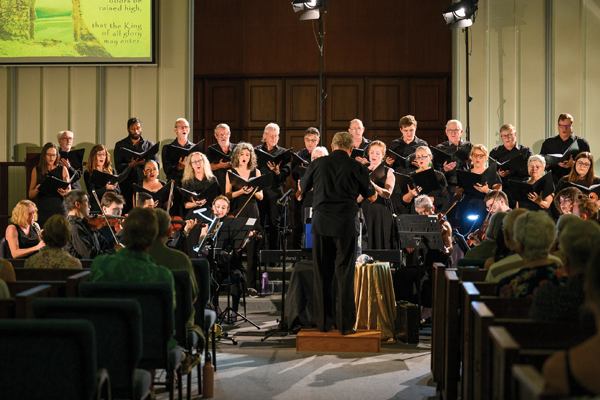
What these colorful characters all have in common, apart from their brilliance as composers, is that they wrote transcendentally beautiful liturgical works that use harmony, polyphony and even dissonance to showcase the power and range of the human voice to move the spirit and stir the soul.
These glorious pieces, composed for Masses and brought to life by the talented singers of Vocalective, are accessible and enjoyable by all, regardless of religious persuasion.
For Vocalective Music Director Michael Loughlin, an unexpected highlight of the concert is a work by contemporary Estonian composer, Pärt Uusberg.
“This is just something out of left field, it’s really out of the box ... For instance, the very last movement ... becomes a round, so there are eight parts ... so you end up with this amazing sound, like knives in the air or something, this dissonance which is not unpleasant at all. It’s quite amazing to hear it. It’s very imaginative writing,” Loughlin explains.
For Loughlin, discovering new works, such as the Uusberg piece, is one of the things he loves most about conducting choral repertoire. It’s also a chance to take audiences on a journey to some unexpected sonic landscapes.
“We go from the 1500s right through to the present day with samples of these great works by all of these composers ... It’ll be a feast of choral sounds going through the concert.”
Music of the Masses
WHEN SAT 6 SEP | 3-5PM
AT DARWIN MEMORIAL UNITING CHURCH
COST $30 | $25 CONC/CHILD
INFO facebook.com/ vocalective.singers
Image: Paz Tassone